



This question dives deep into Hindu cosmology, theology, and symbolism. To truly understand why Lord Krishna is the 8th Avatar of Vishnu, rather than the 1st, we need to explore the answer from mythological, philosophical, and symbolic perspectives.
The Dashavatar Sequence & Its Evolutionary Logic
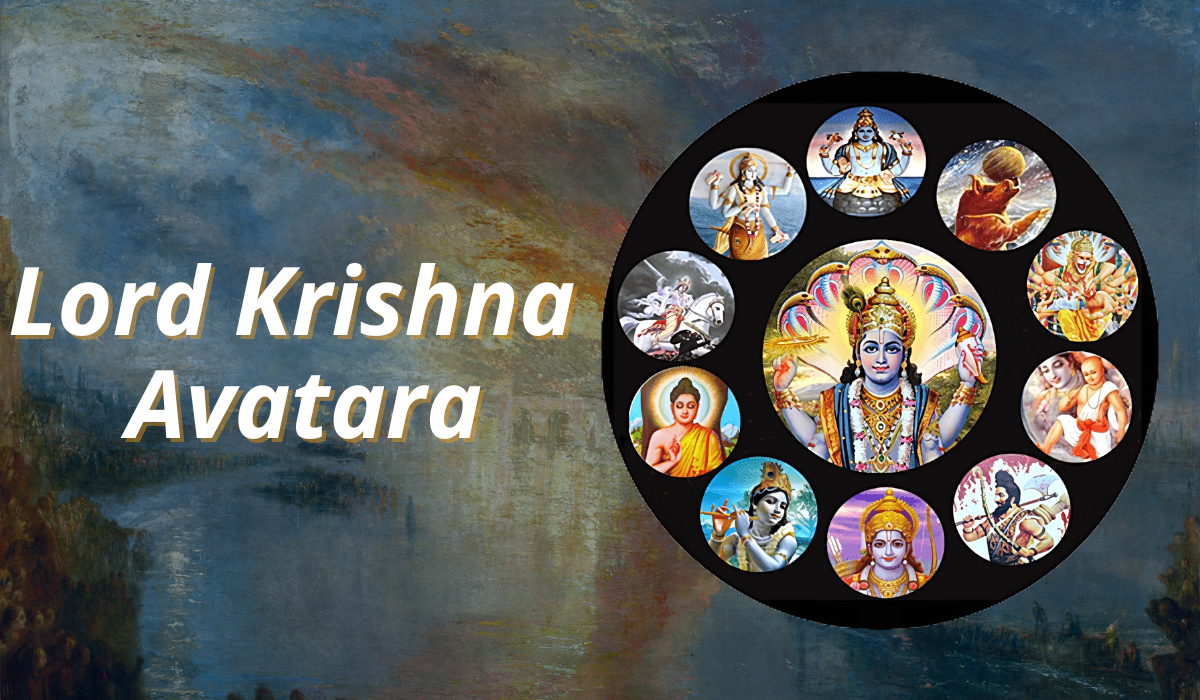
In Hinduism, Lord Vishnu manifests in ten principal incarnations—known as the Dashavatar—to restore Dharma (cosmic order) and destroy Adharma (chaos or evil).
These Avatars follow a purposeful order, reflecting:
- The evolution of life on Earth
- The complexity of societal challenges
- The growth of human consciousness
Dashavatar in order:
- Matsya (Fish) – Aquatic life
- Kurma (Tortoise) – Amphibian/reptilian stage
- Varaha (Boar) – Terrestrial animals
- Narasimha (Man-Lion) – Half animal, half human (transition stage)
- Vamana (Dwarf) – Early human form
- Parashurama – Primitive warrior
- Rama – Ideal king and embodiment of virtue
- Krishna – Divine strategist, philosopher, and teacher
- Buddha – Spiritual guide and reformer
- Kalki – Future destroyer of ultimate evil
Key Insight: Krishna arrives as the 8th Avatar because the world had to evolve through these earlier phases before it could understand the depth of his spiritual and philosophical teachings.
Philosophical Timing – Krishna’s Role in Dvapara Yuga
Hindu cosmology divides time into four Yugas (ages). Krishna incarnated at the end of Dvapara Yuga, right before the beginning of Kali Yuga.
At that time:
- Society was morally complex and divided.
- Evil had evolved into sophisticated, strategic forms (like Duryodhana and Shakuni).
- Righteous people were confused about duty in a world full of grey areas.
Krishna’s mission was not merely to destroy villains but to redefine Dharma and give humanity an eternal guide—the Bhagavad Gita.
Purpose-Based Avatars – Each Responding to a Specific Crisis
Vishnu’s Avatars are not random; each responds to a unique crisis:
- Matsya, Kurma, Varaha – Saved life itself from cosmic threats.
- Narasimha – Destroyed tyranny that could not be defeated by mortal means.
- Vamana – Stopped excessive power of kings and restored cosmic balance.
- Parashurama – Checked the arrogance of warrior clans.
- Rama – Showed the ideal conduct for a ruler and a person.
By the time of Krishna, the crisis was more subtle—the need for spiritual clarity, political diplomacy, and moral courage in an era of deceit.
Thus, Krishna’s arrival earlier would have been premature; the world had to be ready for his Gita wisdom.
Symbolism of the Number 8 in Krishna’s Avatara
The number 8 is deeply symbolic:
- Infinity (∞) when turned sideways – representing Krishna’s eternal, boundless nature.
- Cosmic Balance – In Vedic numerology, 8 stands for karma, justice, and universal law—precisely what Krishna came to restore.
- Transcendence – The 8th position signifies spiritual evolution beyond the material plane, matching Krishna’s mission of uniting Bhakti (devotion), Jnana (knowledge), and Karma (action).
Conclusion – Why Not the First Avatar?
Shri Krishna did not appear as the 1st Avatar because:
- The spiritual maturity needed to absorb his teachings was not yet present.
- Each Avatar builds upon the foundation laid by the previous one.
- The 8th position perfectly matches Krishna’s infinite, balancing, and transformative role.
- His purpose was unique—not merely to destroy evil but to guide humanity into a morally challenging future.